Яндекс.Метрика
Exporting messages from Pachca

Exporting messages from Pachca

How to export messages from Pachca: data format, settings and export limitations

Export guide

Exporting messages via the API: requests and archive format

A message export is an archive of JSON files containing every message from every chat created in your workspace. It's available on the Corporation plan only.

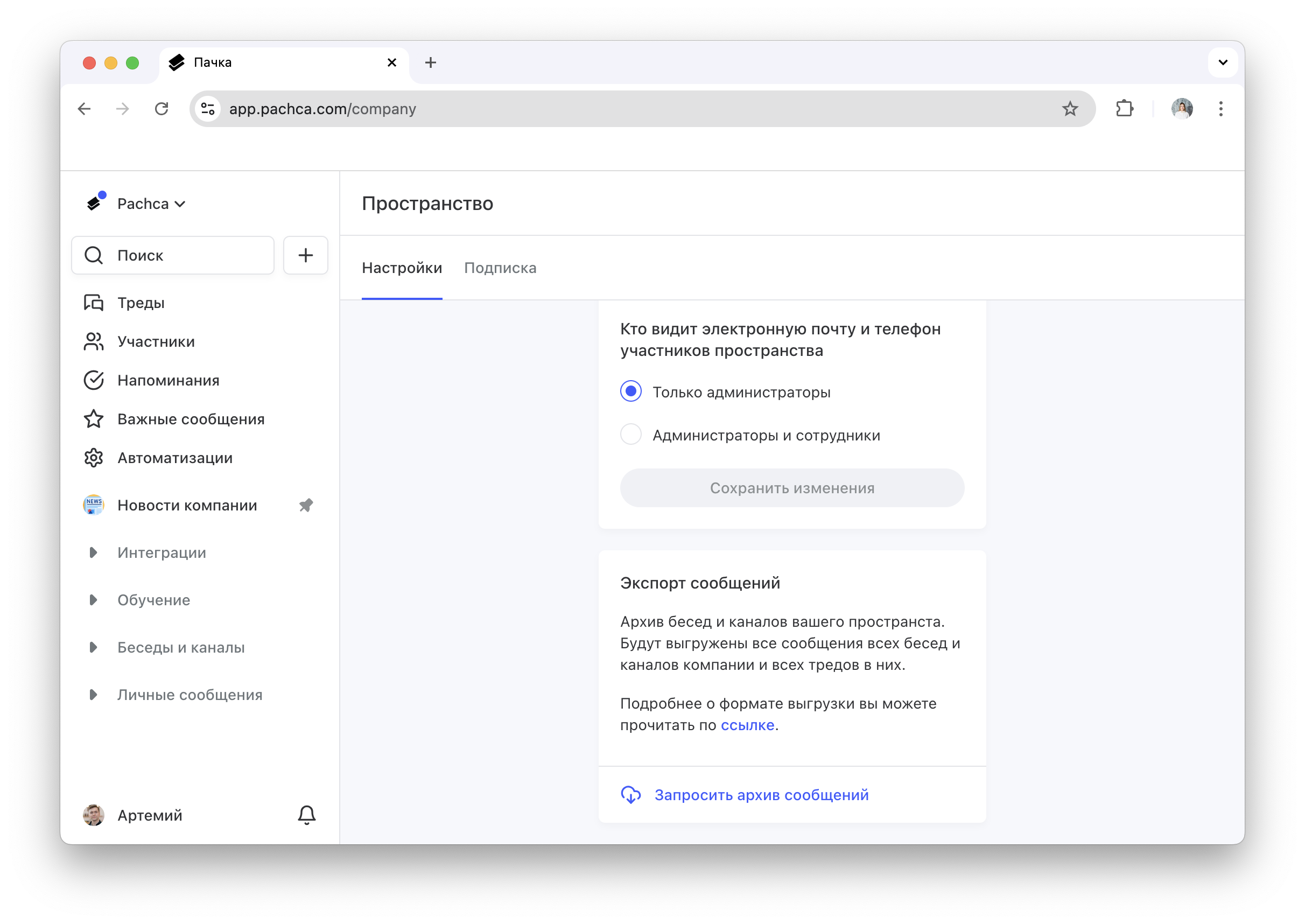
You can request an export in your workspace settings, but only the company Owner in Pachca can do it.
__wf_reserved_inherit

The export includes all messages from public, private and archived chats, including threads. For each message, you get the author, the time it was sent, the text and the list of reactions to it.

The export also includes direct messages, but in a limited format: the message author and the time it was sent, without the content of messages and threads. This data is useful for gauging employee engagement and activity, or for estimating each team member's workload.

Settings and limitations

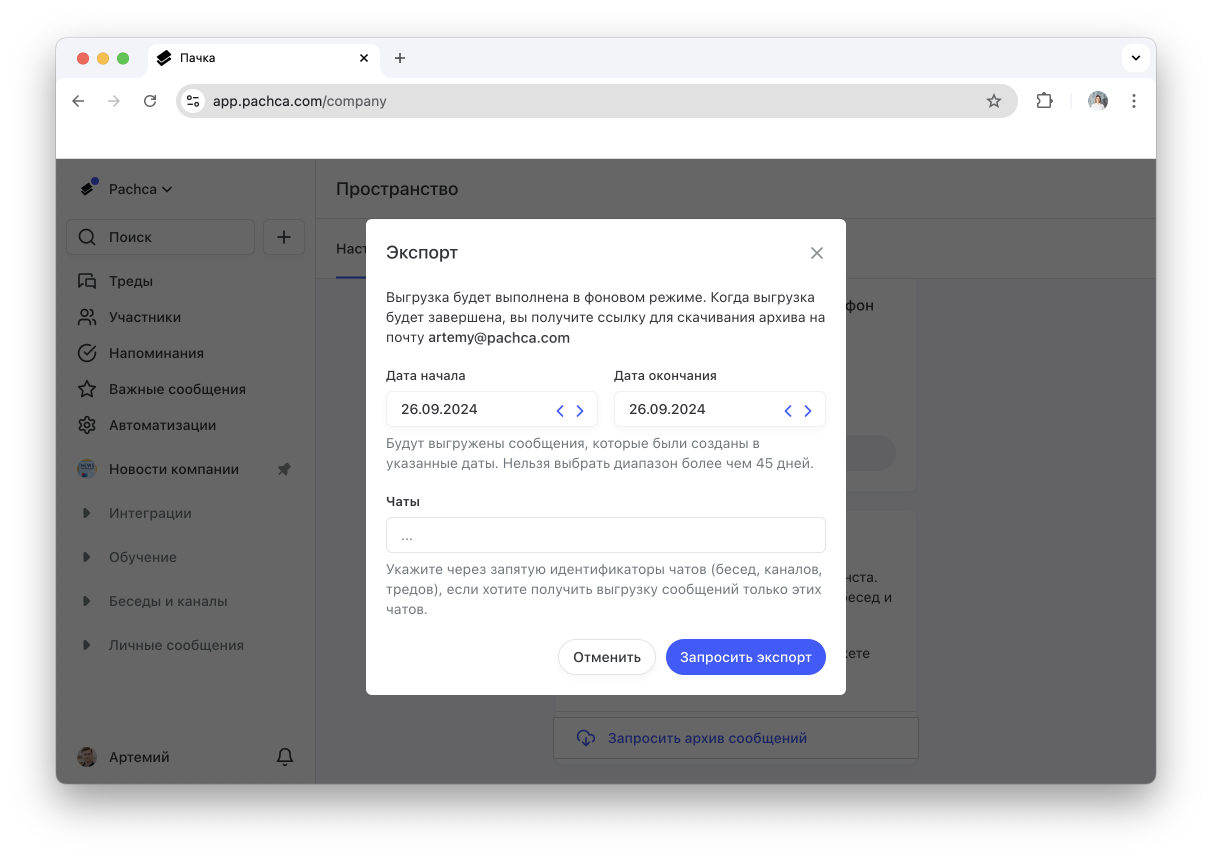
When you request an export, you can set the period you want data for and add the IDs of the chats you want to export. If you need data for a longer period, request another export with a new date range once the first one is done.
__wf_reserved_inherit

Current export limits (the maximum period and what is and isn't included in the archive) are described in the export guide on the developer portal.

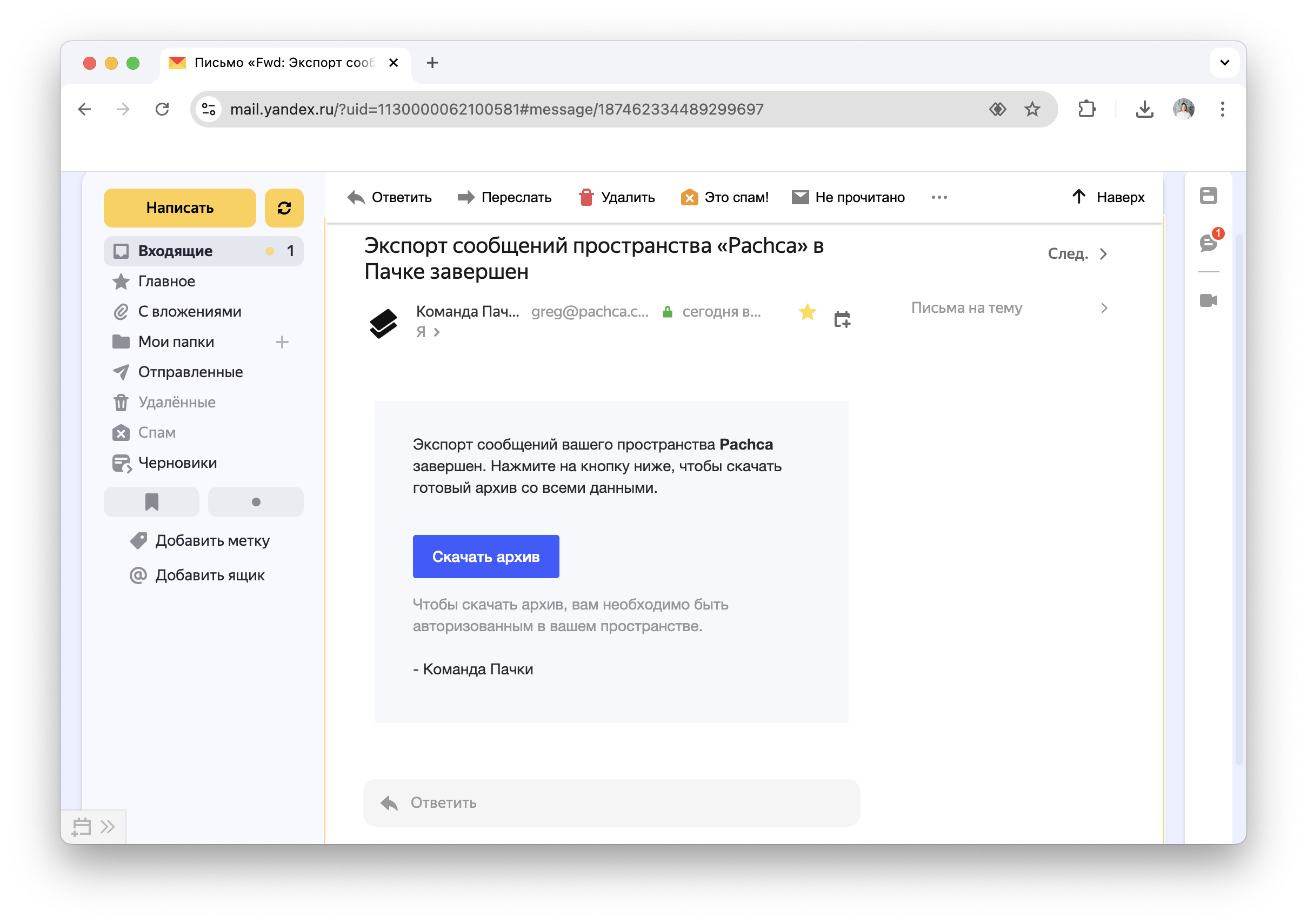
The export runs asynchronously, so you can keep working in Pachca after you request it. When it's ready, the company owner gets an email with a link to download the archive.
__wf_reserved_inherit

Message export format

The archive is split into folders, one for each chat in the workspace. Each folder contains JSON files, one for each day of conversation. The full structure of the archive and all its fields is described in the export guide.

Use the export to measure the number of messages and reactions in shared chats. This lets you calculate your engagement rate and improve company culture and communication. You can also count active chats and see how much discussion is happening across your company.

Updated: April 1, 2025

More in Administration

Accounts in Pachca
How Pachca is structured: the difference between an account, a user and a member profile
Inviting your team
How to invite your team to Pachca, the team chat app: two ways to add employees
Change your email in Pachca
How to change your email address in Pachca: a guide for employees and administrators
Errors when adding people by email
Common errors when adding users to Pachca by email and how to fix them
Managing members in Pachca
Managing members in Pachca: how to add, edit and remove people from your team
Group tags
Add employees to all the chats they need at once with group tags
Advanced administration via API
How to automate user administration in Pachca with the API: creating users, managing them and tags
Ports and addresses Pachca needs
Ports and addresses Pachca needs to work properly: setting up your corporate firewall
Storage in Pachca
Everything about file storage in Pachca: limits, managing storage space and working with documents
Setting up DLP in Pachca
Add an extra layer of protection for personal data, tokens and passwords
Internal/external file access
How to set up internal and external zones in Pachca to protect your company documents
Two-factor authentication (2FA)
How to turn on two-factor authentication in Pachca for extra account security
Import chats from Slack
How to import your chat history from Slack into Pachca: a step-by-step migration guide
Import chats from Mattermost
Pachca lets you move your chat history and files from Mattermost into your workspace.
Import chats from Telegram
If your team is moving to Pachca from Telegram, you can bring your chat history over to your team chat app.
SSO options in Pachca
Single sign-on (SSO) in Pachca: SAML, LDAP and Keycloak connection options and step-by-step guides
SSO in Pachca with LDAP
SSO in Pachca with Multifactor.ru
SSO in Pachca with Blitz Identity Provider
SSO in Pachca with Authentik
SSO in Pachca with Keycloak
SSO in Pachca with Azure OpenID
SSO in Pachca with ADFS OpenID
This guide explains how to configure ADFS on Windows Server 2016 or later to connect it to Pachca.
SSO in Pachca with Google Workspace SAML
SSO in Pachca with Indeed IdP over SAML
SSO in Pachca with Yandex 360
SSO in Pachca with Yandex Identity Hub
BYOK: Bring Your Own Key in Pachca
How encryption with your own key (BYOK) works in the Pachca team chat app
Advanced encryption in Pachca
How to set up advanced encryption in Pachca for extra protection of your company data
Set up BYOK with HashiCorp Vault
Set up BYOK with Yandex KMS
Set up BYOK with Cloud.ru KMS